This position paper originally appeared in The Learning of Mind: How Do You Figure Out What a Mind Is? Play, Creativity, Fiction, and Fantasy, a section inToward a Theory of Mind, Tanya Marie Luhrmann, ed., Suomen Journal of the Finnish Anthropological Institute 36, 4 (2011): 39-41.
I feel both singularly unqualified and singularly qualified to contribute to the fashioning of an anthropological theory of mind. In my research in Biak, an island group in the Indonesian-occupied part of Melanesia, West Papua, I struck out when it came to collecting explicit accounts of how minds and bodies work. I’m not so sure that the term ‘theory’ captures what is going on when people make inferences about what others are thinking, feeling, or doing. I’m not sure we’re going to make the most of what anthropology has to offer to thinking on this topic if we limit our task to the comparison of theories of mind.
But in another sense, I am qualified for this conversation. For reasons having less to do with my research on Biak than with my unusual domestic situation, I’ve given a good deal of thought to the question of how children develop the ability to stand in another’s shoes. I’m not quite an auto-ethnographer, but I come close. I feel qualified to share some ideas about theories of mind—and what I see as shortcomings in the theory—because I am a participant observer who is tightly enmeshed in a tiny social world I feel compelled to describe.
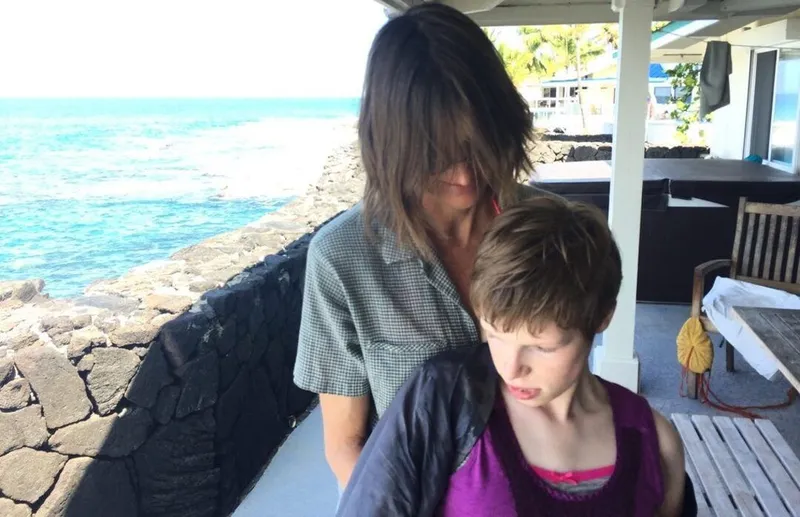
This tiny social world revolves around my eleven-year old daughter, Millie. Millie does not walk without support. She does not talk. She rarely makes eye contact. She is what the doctors and bureaucrats call ‘severely to profoundly retarded’. They say she has a mental age of between nine and eleven months. It is hard to imagine Millie entertaining a theory. Some might even see her as belonging to the ranks of Clifford Geertz famously described as ‘unworkable monstrosities’, ‘men without culture’, given her apparent lack of language or much in the way of signs. I have a personal and professional interest in seeing Millie otherwise. For me, Millie is one of the most instructive social beings I have ever met.
This is because Millie challenges our presumptions on the nature of sociality—our deep-seated prejudices on the way in which intersubjectivity happens amongst humans (and perhaps other animals). She brings to light the embodied connective tissue on which rests the relationship between self and others and all the multifarious modes of human action, from gossiping to doing math. I’ve just begun investigating the practices of belief that come to light in the therapeutic settings set up to serve children like Millie, who seem stalled on the cusp of communication. Based on what some have called ‘the doctrine of the least dangerous assumption’, speech therapy rests on faith: the faith that one can create a speaking subject by responding to seemingly random gestures—a burp, a twitch—as though they were intentional signs.
But I’m also after something more elusive than these practices, which one can study by talking to experts. This has led me to start taking field notes like the following in which I try to understand Millie on her own terms:
[Millie] is more determined than anyone I know. She tries hard to get herself moved into a position in which she can reach one of those toys in her room that she loves the best—things with strings, things with straps, things with zippers—toys only in the loosest sense, the sense that accommodates fleece vests, shoe laces, Keene sandals, and long hair. Most recent example: It’s Easter. Non-conventional parent that I am, I do not awaken in the same house as both of my Bunny-worthy children. Ralph [my fourteen year old] wakes up in LA with his cousins, with whom he had just spent a week skiing. Millie wakes up in Santa Cruz, but by then I’m long gone, up at Lexington Reservoir with the other pagan scullers out for a morning row. On the way to San Jose Airport afterwards, I stop at a coffee house in Los Gatos. Why are all these people so dressed up? Why is everyone talking about church? Is Los Gatos not only whiter and richer than Santa Cruz—is it also more Christian, too? Easter. Fortunately, I did have my act together enough the night before to buy baskets, grass, crème eggs, jelly beans, and lots of Peeps—and the nicest Easter themed toys I could find for Millie at CVS. (Real toys: a bunny that bends. A sheep that bleats. A funny ball with feathers.)
It’s 3 p.m. Time for the egg hunt! Ralph makes pretty short work of it—he came home with a suitcase full of Best-Rogowski chocolate but he’s still motivated enough to find eight cream eggs. Meanwhile, Millie has turned her attention to her basket. Izzi walks her out of her bathroom holding her shoulders to help her balance, knee poised to prompt Millie to step by applying gentle pressure to the opposite buttock. No need. Millie is lifting her knees, Gestapo style. Marching forward. She sees the grass. She’s smiling. She’s squealing. She’s taking huge steps.
When she gets within two feet, she stops walking and leans forward, holding out her arms, reaching with her fingers, giggling hysterically. We laugh with her—she laughs even harder when she hears us laugh. One more step. She’s forgotten about stepping, so determined is she to grab this stuff—she’d rather fly or dive into the little pile of shredded green paper.
But then she is there. She grabs a fistful. It’s not coming out quickly enough. She grabs the basket by the handle and shakes it upside down. Jelly beans spray onto the couch and carpet. (Look out for the dog!) She squeals. The bendy bunny catches her eye; she catches him by the leg—but she’s not ready to give up the grass, looking over her shoulder to see where it went. Izzi turns her to sit on the couch—she can do this now, unsupported—I gather up the grass and jelly beans, unbending her fingers to release the final piece, and carrying her basket, along with Ralph’s, to the kitchen. She keeps looking for them, not giving the bleating sheep the attention it deserves. I put the baskets back into their original hiding place—in the kitchen cupboard. She still gazes in their direction wistfully.
Determination.
Millie experiences the world around her through channels quite unlike those used by typical people. Millie has trouble organizing her visual field; she prefers to rely on sound and touch. It’s not surprising that strangers find it hard to interact with her. Millie doesn’t share attention by following the gaze of another; instead she vocalizes, laughing merrily when someone imitates her sounds. She doesn’t lock eyes; instead she strokes flesh, gently fondling people and their clothing, reaching for their jewelry, laces, and belts.
Although Millie has not been labeled autistic, scholarship on this topic has provided me with useful leads for thinking about her experience. Critics of the theory of mind theory of autism have raised the possibility that what researchers have described as a ‘deficit’ in autistic children could in fact stem from their atypical ways of organizing their sensory field. Some have even suggested that intersubjectivity begins with proprioception: our reflexive experience of our bodies in time and space. We need not define autism as a lack of sympathy, to use an eighteenth century term for the ability to identify with others. We could view it as sympathy in another key.
Anthropologists often get cast in the role of naysayer. For the purposes of this project, I’m wondering whether we can use our comparative method in more sophisticated ways. Linguistic anthropologists have described how people’s “language ideologies” foreground certain functions of language, while leaving others unremarked. I wonder whether we could coin a new term—”sensory ideologies”—to describe how people navigate the multiple avenues that are available for entering the give and take that makes humans what they are. My daughter’s ways may seem strange. But they may well bring to light capacities that all of us share.